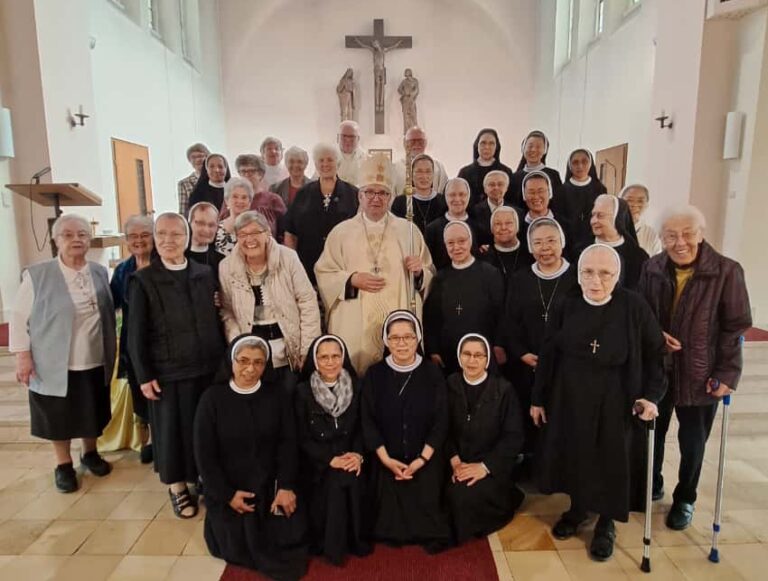
Homily for the Founding Feast of the Congregation of the Sisters of Divine Providence
Monday, September 29, 2025 – 9:00 a.m.
(As delivered)
In the middle of the 19th century, Bishop Wilhelm Emmanuel von Ketteler founded the Congregation of the Sisters of Divine Providence. To this day, you continue to live and serve here at the place of your foundation in Mainz-Finthen.
As bishop, I look with deep gratitude, together with you, upon the decades of faithful service in following Jesus. For today and the future – even in times of great change – we can continue to place our trust in God’s Providence.
The sisters have served, and continue to serve, in many areas: with children and youth, in schools and education, and in pastoral care – always close to the people.
As bishop, I can learn from you what it means to trust in God’s Providence. He continues to guide the Church even today. On your website, I read a prayer from your 1995 General Chapter:
WE PRAISE YOU, O LORD, FOR YOUR PROVIDENCE, AND WE ENTRUST OURSELVES TO YOUR LOVING CARE
– with praise and gratitude for the good and beautiful things we have received,
– with confidence when we encounter our limits,
– with surrender to your mysterious divine will in suffering and disappointment.
WE LIVE FROM YOUR PROVIDENCE; HELP US TO MAKE IT VISIBLE IN OUR WORLD
– through faithfulness, living as responsible stewards of the earth and of our personal gifts,
– through courage, committing ourselves to goodness and justice in our time,
– through compassion, making the joys and sorrows of your people our own,
– through hope, working together with people of goodwill in building your Kingdom.
This is a prayer I can wholeheartedly join for our diocese.
Life in the discipleship of Jesus is not always a path of sunshine, but Christians can live in the confidence that God will never abandon His Church.
It takes courage to follow Him, compassion as a Christian attitude, and hope that something in this world can indeed be changed.
You, dear Sisters, embody all of this today. Your congregation has lived it through the decades – and continues to live it now.
The essential concerns of your congregation are also the concerns of the Church and of the society in which we live today.
From the very beginning, your congregation has been in touch with the times, close to the joys and hopes, the questions and worries of the people.
Much has changed over the years; the world has become a different place. Yet, as Church, we should not retreat into our shells and let the world simply pass by.
We should see ourselves as part of this world, while remembering that our faith in God provides a strong foundation.
In your prayer above, you express the Christian principle of vicarious representation:
Where others no longer believe or hope, you continue to live that faith and hope. In doing so, you fulfill the very mission of the Christian life.
Divine Providence does not mean that everything happens automatically.
Yes, God has a plan for this world and for every individual person.
But He needs people who lend Him their hands and feet, their mouths, hearts, and minds.
The original charism of your congregation also included compassion for the people of your time.
To do this, one must know the reality of those people – but also look to Christ, the incarnate and crucified Lord.
Whoever looks upon Him learns compassion. And through compassion, society can be transformed.
In the Church of St. Ludgerus in Münster, there is a crucifix that expresses this in a striking way: it is a Crucified Christ without arms, which He lost during a bombing raid in World War II.
Beneath the cross stands a prayer from the 14th century:
Christ has no hands but our hands to do His work today.
He has no feet but our feet to lead people on His way.
Christ has no lips but our lips to tell others of Him.
He has no help but our help to bring people to His side.
Of course, we must not misunderstand this text – God always has greater power and possibilities than our human ones.
But if we look closely at the Gospels, we see that Jesus entrusts His disciples with the task of making the Kingdom of God present in the world.
Just as He bore the Cross out of love, He does not wish to act without us.
We are His hands that do good, His feet that carry the Gospel, His lips that proclaim the Good News.
Christ becomes powerless when we refuse Him and fail to make Him visible.
You, dear Sisters, have made Him visible for many decades.
To remain sensitive to suffering and close to people, prayer is essential.
On your website, you also bear witness to this:
For us Sisters, common prayer is a central part of our day and an expression of our faith.
In these moments we turn anew toward God and toward people.
The Liturgy of the Hours, prayed together at specific times of day, holds a special place:
Lauds in the morning and Vespers in the evening form the anchors of our prayer life.
In the rhythm of creation and in the prayer of the Church, we find comfort and connection.
Millions of believers around the world are united in prayer – an experience that moves and inspires deeply.
As we pray and meditate on the psalms, we view our own existence from God’s perspective and draw new strength for daily life.
Prayer is more than a religious exercise – it is our connection to God, a source of community, and a renewal of spirit.
Whether in silence or together, shared prayer brings comfort, strength, and hope for each day.
This prayer, too, is an act of representation.
Many people can no longer, or no longer wish to, pray – yet you include them in your prayer.
I am deeply grateful for your presence in our diocese.
How do you envision the Church? Smaller, or more international?
On your website, you emphasize the bond that transcends all borders.
That is a richness you bring to our diocese – and one that you live out across the world.
As a universal Church, we enrich and strengthen one another. Sometimes we must also endure and shape the diversity of cultures and expressions of faith.
You live this service of representation and example as well.
I thank you for your service, your faith, your congregation, and your prayer.
It is a blessing that you live here, broadening our vision and our horizons.
For all that lies ahead, I wish you from my heart God’s abundant blessing.